The Quality & Colour Of Our Diamonds
Important! Our diamond grades are genuine and not exaggerated. Beware of other retailers selling comparable advertised grades for unrealistically low prices.
If the following seems daunting just call us on 0845 084 1200 and we will point you in the right direction.
Premium Quality - Colour H/I and Clarity I1-2 |
|
H/Si Quality - Colour H and Clarity Si |
|
G/Vs Quality - Colour G and Clarity Vs |
Further Diamond Quality Information
At The Diamond Store we essentially use a higher quality of diamond than those that you would generally find in the high street shops.
Some products may have better quality than our usual high standard of diamonds. On these products, you will notice the letters H/Si or G/Vs mentioned. The first letter refers to the colour and the subsequent letters refer to the clarity grading ie. the level of inclusions in the diamond.
For best value we would recommend choosing colours between H – J on the scale, especially for individual diamonds of 0.50Ct and under. For the more discerning diamond earring buyer, we would recommend F - G.. Anything above that, you can rarely tell the difference and would matter more to a person buying purely for investment purposes. Please see the charts below:
The Colour

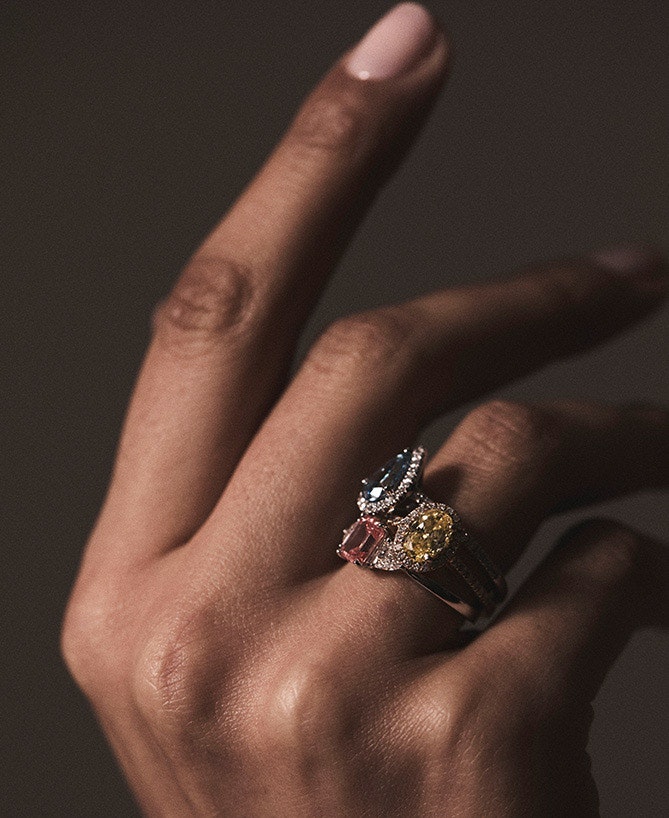
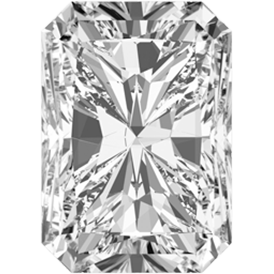
Diamonds are actually found in all colours of the rainbow although white (colourless) is the most popular colour and usually the most desirable. Fancy coloured diamonds are the rarest with an intense colour like yellow, pink or blue but they are not graded on the same scale.
Diamonds are colour graded on an alphabetical scale that ranges from the letter “D” (colourless) all the way to “Z”. The variances between the grades on the scale are minimal but make a big difference to the price of the diamond.
The scale originated from the Gemological Institute of America (GIA) and diamonds are graded by comparing them to the GIA’s set of master stones of differing shades of colour.
The bigger the diamond the more noticeable the colour becomes. The average diamond earring buyer will be looking for diamond earrings that don’t look too yellow whilst avoiding the high value top end of the scale. Diamond earring buying in practice involves a lot of compromise!
The Diamond Clarity
The reason why diamonds are so expensive is because they are so rare. When you look at a diamond, you may see some flecks of dirt inside the diamond. These are minerals that get trapped in the diamond as it is being formed over millions of years. The white inclusions that may look like mini feathers are natural fractures in the diamond structure. Needless to say, the cleaner the inside of the diamond looks, the rarer it is to find and so the value of such a diamond is much higher.
The clarity of a diamond is measured from flawless to heavily included on a scale established by the Gemological Institute of America (GIA):
FL – Flawless
Even under a jeweller’s loupe (10x magnification eye-glass) inclusions can not be seen. Matching flawless Diamond Earrings are extremely rare and so expect to pay a high price.
VVS I – Very Very Small Inclusions
Extremely small inclusions difficult to find, even if using a jeweller’s loupe. You may see this category expressed as VVSI1 or VVS2, where VVS1 is slightly cleaner than VVS2. Again, these are very rare to find.
VS I – Very Small Inclusions
These inclusions will be hard to spot with the naked eye; however, once you look under magnification, you will be able to spot inclusions that are affecting the diamond clarity. Available as VS1 and VS2.
SI – Small Inclusions
On stones weighing 0.25ct and above, inclusions affecting the clarity of a diamond can be seen to the eye. However, more often or not, these inclusions can be hidden by the metal claws that hold the diamond in place. SI1 or SI2 represent good value for diamond earrings without having to spend too much money. Unless you push your nose to the diamond, inclusions are hard to spot.
I – Inclusions
Often seen as I1, I2 and I3 these grades are used to describe diamonds that have inclusions visible to the eye. The inclusions can be various shapes, sizes and colours. Care should be taken when buying these diamonds to avoid disappointment! In the smaller diamond sizes (0.15ct and below) flaws will be less obvious as long as they are not dark in colour and do not look like crystals of sugar!
Diamonds are beautiful. Care should be taken not to fall in to the trap of searching for a particular quality combination. A quality diamond earring jeweller will be able to guide you to the best combination for your budget. As each diamond is unique, grades about the clarity of diamonds should only be used as a guide.